
What Vedic astrology is, and what it is not
Vedic astrology, often called Jyotisha in Sanskrit sources, is a family of astrological traditions that developed in South Asia over many centuries. Like other forms of astrology, it works from the assumption that celestial bodies, particularly the planets and the stars, bear some relationship to events and characteristics on Earth. Encyclopedic overviews of astrology describe this as a method of relating sky positions to mundane and personal matters, and they are careful to present it as a historical and cultural system rather than an established science. That framing matters for beginners. Vedic astrology is a rich interpretive tradition with its own vocabulary, texts, and techniques, and it is also a set of claims about the world that has not been demonstrated by controlled evidence. A beginner can study it seriously as a cultural and symbolic system without treating its statements as verified fact. The Hindu American Foundation notes that competent practice in this tradition is generally understood to require years of academic study and training, which is a useful corrective to the idea that a weekend course makes anyone an authority. Approaching the subject with curiosity and appropriate caution is not skepticism for its own sake; it is the attitude that lets you learn accurately.
The birth chart as a calculated document
The foundation of most Vedic practice is the birth chart, or kundali. Before any interpretation happens, the chart must be calculated, and calculation is a distinct step from meaning-making. A practitioner needs the date, an accurate time, and a place of birth. From these, the positions of the Sun, Moon, and planets are computed against the background of the zodiac, and the sky is divided into twelve houses or bhavas. In the Vedic system, the zodiac is typically measured sidereally, meaning relative to fixed stars, which differs from the tropical zodiac used in much Western astrology; this is why the same birth moment can produce different sign placements in the two systems. The difference arises from astronomical convention, not from one system being more sincere than the other. The ascendant, or rising sign, depends heavily on the exact birth time, so an uncertain time produces an uncertain chart. Software can perform the arithmetic quickly, but the output is only as reliable as the input. Beginners should understand that a chart is a computed diagram first: a map of where celestial bodies were, expressed in a traditional coordinate system. Everything after that point is interpretation, and interpretation deserves to be labeled as such.
Planets, signs, and houses: the basic vocabulary
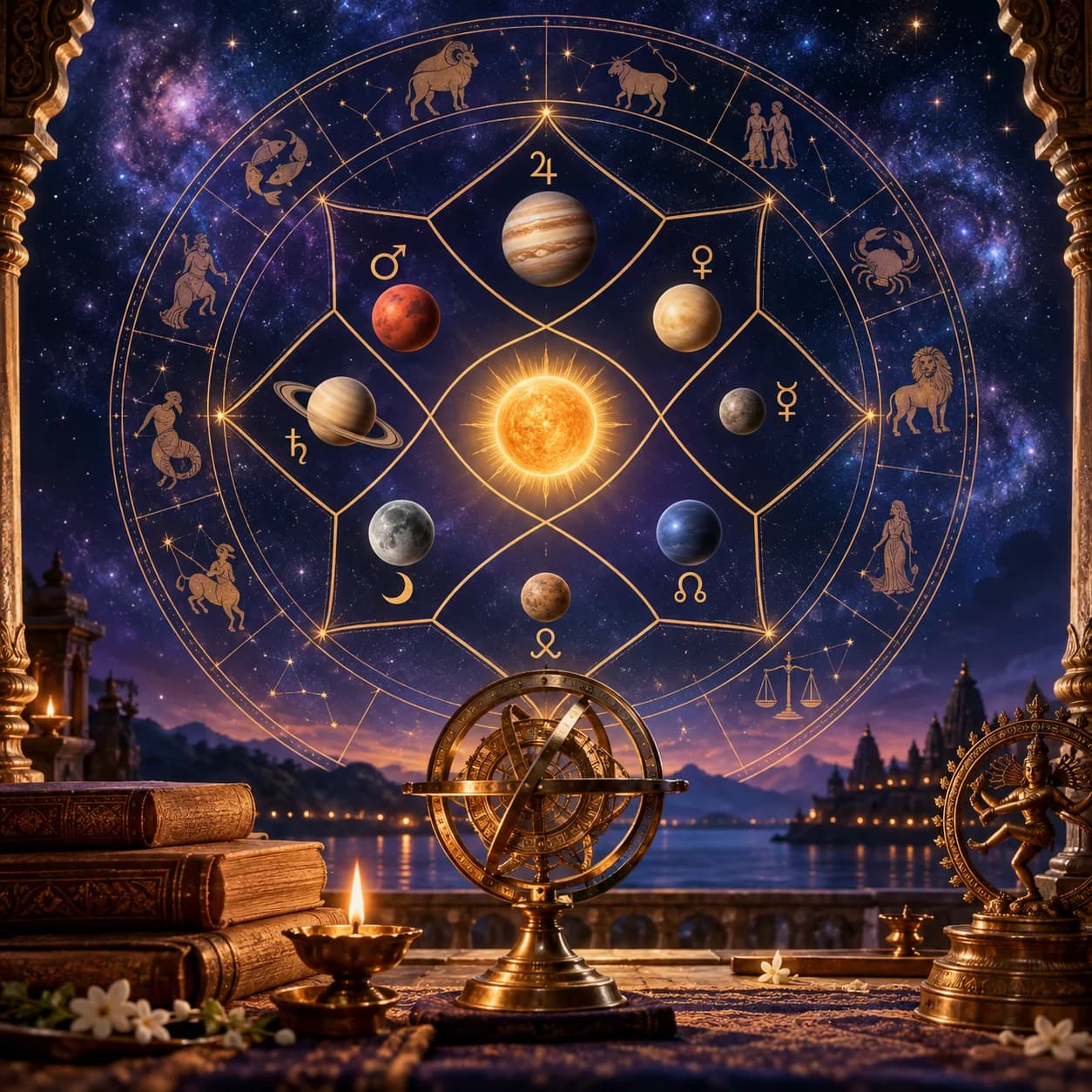
Once a chart exists, the beginner meets its vocabulary. Nine grahas are conventionally used: the Sun, Moon, Mars, Mercury, Jupiter, Venus, and Saturn, along with the lunar nodes, Rahu and Ketu. Each is associated with themes in the tradition, and each occupies a sign and a house in the chart. The twelve signs carry elemental and temperamental associations, and the twelve houses are linked to areas of life such as body, family, work, and partnership. Planets also form relationships with one another, including friendships, enmities, and aspects, and these combinations are where much of the interpretive complexity lives. A responsible introduction should resist the temptation to reduce this vocabulary to a list of fixed meanings. In practice, traditional authors describe planets as conditioned by sign, house, and company, so the same planet can be read very differently in two charts. Beginners often want a simple dictionary, and a dictionary is a reasonable starting point, but it is not the whole grammar. The Hindu American Foundation's overview emphasizes that the tradition is oriented toward themes such as dharma, meaning, purpose, and honor in a person's life, which suggests that the system is best understood as a framework for reflection rather than a machine for producing verdicts.
Where calculation ends and interpretation begins
The most useful distinction a beginner can learn is the line between calculation and interpretation. Calculation answers factual questions: where was the Moon at a given moment, which sign was rising, which house did a planet occupy. These answers can be checked against astronomical data and are either right or wrong, within the limits of the input. Interpretation answers a different kind of question: what does this configuration mean for a person's life, temperament, or prospects? Here the tradition offers readings, not measurements. Two competent practitioners can look at the same chart and emphasize different themes, because interpretation draws on textual precedent, school of practice, and judgment. This is not a flaw unique to Vedic astrology; it is characteristic of symbolic systems generally. The practical consequence for beginners is to keep the two categories verbally separate. Say "the chart places Saturn in this house" when describing calculation, and say "the tradition associates this placement with themes of discipline or delay" when describing interpretation. That habit protects you from sliding from a computed fact into an unearned certainty, and it makes your reading of any astrological text more precise.
Common beginner mistakes and how to avoid them
Several mistakes recur among newcomers. The first is treating a Sun-sign summary as if it were a chart reading; a single placement is a fragment, and popular horoscope columns are not the same genre as chart analysis. The second is ignoring birth-time accuracy. Because the ascendant and house divisions shift quickly, an approximate time can change the chart substantially, and a reading built on a guessed time should be presented as provisional. The third is over-reading a single factor. Traditional practice weighs multiple indicators together, and a beginner who seizes on one placement will usually overstate it. The fourth is confusing confidence with competence. A fluent reading is not evidence of accuracy, and the tradition's own emphasis on long training suggests that expertise is earned slowly. Finally, beginners sometimes import claims from one system into another without noticing, such as assuming tropical and sidereal sign placements will match. Keeping a notebook that separates calculated facts from interpretive notes is a simple discipline that pays off. It also makes it easier to notice when a claim is being asserted with more certainty than the underlying method can support.
How to study respectfully and skeptically
A sound study path moves from vocabulary to calculation to interpretation, in that order. Begin with the basic terms: grahas, rashis, bhavas, and the logic of the sidereal zodiac. Then learn how a chart is actually computed, ideally by working through a few examples by hand or with transparent software, so that the numbers are not a black box. Only then move to interpretive literature, reading primary or scholarly sources alongside popular guides and noting where they disagree. The Hindu American Foundation's piece is useful for cultural context, while encyclopedic overviews help situate Vedic astrology within the broader history of astrology as a method of relating celestial positions to earthly events. Throughout, keep the limits in view. Astrology is not a substitute for medical, financial, or legal advice, and no chart reading should be used to make consequential decisions with certainty. The tradition can be studied as a system of meaning, a historical artifact, and a cultural practice without being treated as an oracle. That stance is not hostile to astrology; it is what allows a beginner to engage with it honestly, precisely, and with genuine curiosity about why people have found it meaningful for so long.
Sources and further reading
Hindu American Foundation, "5 things to know about Vedic astrology": https://www.hinduamerican.org/blog/5-things-to-know-about-vedic-astrology/ — Encyclopaedia Britannica, "Astrology": https://www.britannica.com/topic/astrology — Navgraha Astro Vastu Gurukula, "How to Learn Vedic Astrology: A Step-by-Step Guide for Beginners": https://navgrahaastrovastugurukula.com/vedic-astrology/how-to-learn-vedic-astrology-a-step-by-step-guide-for-beginners/ — The Good Trade, "A Beginner's Guide To Learning Astrology": https://www.thegoodtrade.com/features/what-is-astrology/ — YouTube, "Astrology Birth Chart Explained": https://www.youtube.com/watch?v=W1s23eDKRQs — Quora discussion, "Why should beginners learn the basics of Vedic astrology before believing common myths": https://www.quora.com/Why-should-beginners-learn-the-basics-of-Vedic-astrology-before-believing-common-myths