
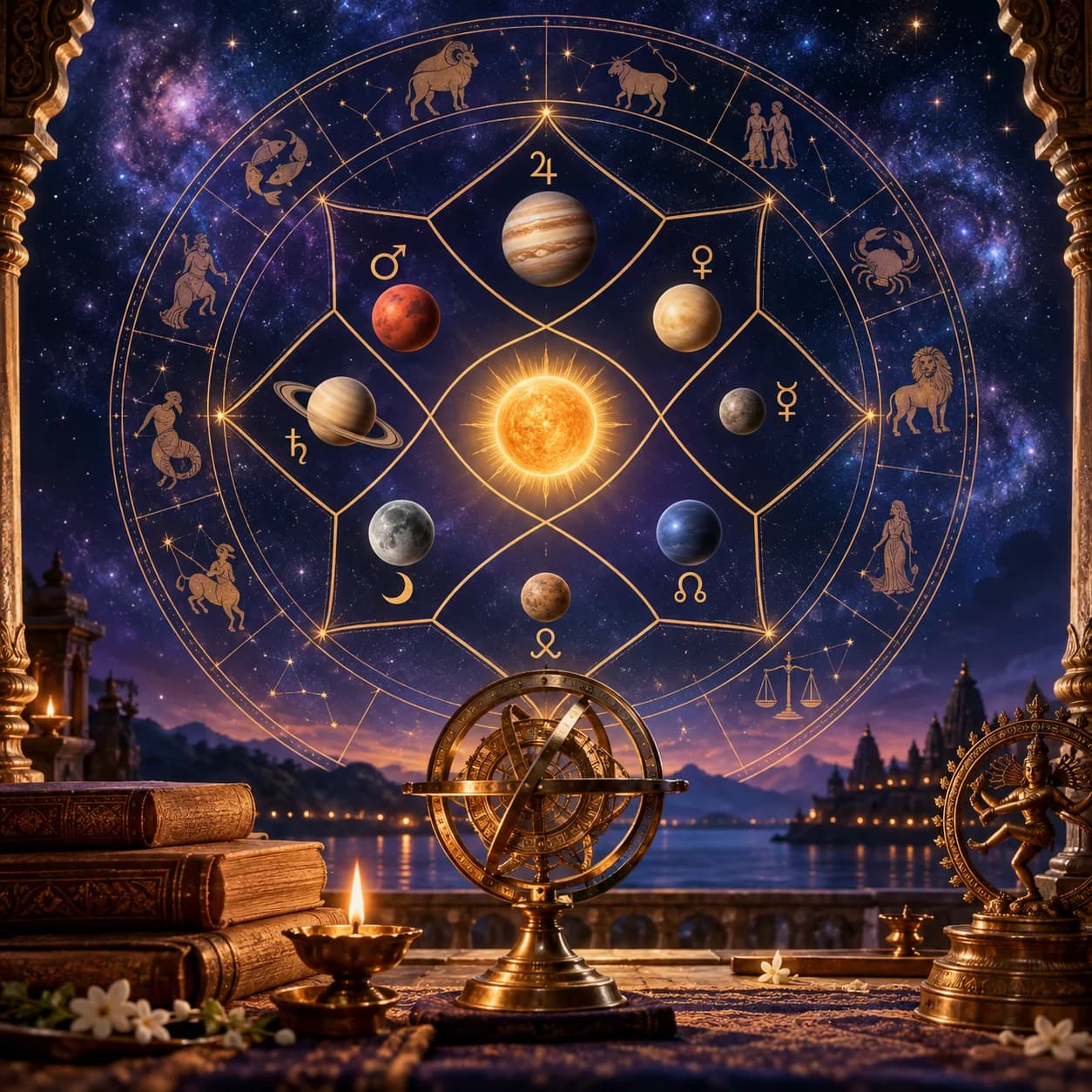
What "Planetary Position" Means in Vedic Astrology
In Vedic astrology, often called Jyotisha, a planetary position is a description of where a celestial body sits relative to a defined zodiac at a defined moment. The tradition works with nine grahas: the Sun, Moon, Mars, Mercury, Jupiter, Venus, and Saturn, plus Rahu and Ketu, the lunar nodes. Introductory sources such as Indastro and Astrokarak consistently describe this set of nine, noting that the two nodes are calculated points rather than physical bodies. A position is usually expressed through several coordinates at once: the sign (rashi) the body occupies, the degree within that sign, the house (bhava) it falls in for a given chart, and its relationship to other bodies through aspects (drishti). Each of these is a separate layer of information, and none of them is meaningful in isolation. The phrase "planetary position" therefore describes a bundle of measurements, not a single fact. Keeping that bundle in mind helps prevent the common mistake of treating one coordinate, such as a Sun sign, as if it summarized the whole chart.
The Astronomy Beneath the Symbolism
Before any interpretation begins, planetary positions are astronomical quantities. The Sun, Moon, and visible planets move along the ecliptic, the apparent path of the Sun across the sky, and their positions can be computed for any date and time using ephemerides. Vedic astrology divides the ecliptic into twelve signs of thirty degrees each and, in the most widely used system, into twenty-seven lunar mansions called nakshatras. The ascendant, the degree of the zodiac rising on the eastern horizon at a given moment, anchors the house system. Because the ascendant changes roughly every two hours, the accuracy of a birth time matters enormously: a small error can shift the ascendant and therefore every house placement. Rahu and Ketu are not observed bodies but the points where the Moon's orbit crosses the ecliptic; their positions are calculated, not seen. This is why careful practitioners describe chart construction as a computational task first and an interpretive one second. The math can be checked; the meaning assigned to the result belongs to a tradition of interpretation.
Calculation and Interpretation Are Different Kinds of Claim
A useful distinction for any reader is between what a chart calculation asserts and what an interpretation asserts. The calculation says, for example, that at a given time and place the Moon was at a particular degree of a particular sign. That claim is testable against ephemeris data and depends on the accuracy of the birth time and the geographic coordinates used. The interpretation says that a Moon in that position signifies something about temperament, emotional style, or the mind. That claim belongs to a symbolic system and cannot be verified in the same way. Many popular presentations blur the two, presenting interpretive statements in the confident tone of astronomy. A grounded approach keeps them separate: the position is data, the meaning is commentary. This does not make interpretation worthless, but it does mean readers should ask which kind of statement they are being given, and should be skeptical when a symbolic reading is dressed up as a certainty.
Signs, Houses, and the Context That Shapes Meaning
A planetary position rarely carries a fixed meaning on its own. Classical and modern introductory material alike emphasize context: the same planet behaves differently depending on the sign it occupies, the house it falls in, its dignity or debilitation, whether it is retrograde, and which other planets aspect it. The house system ties positions to life topics, such as body, resources, siblings, home, creativity, health, partnership, and so on, though the exact assignment of topics varies across texts and schools. Aspects add another layer: in Vedic practice, drishti is often described as a directional influence, with some planets casting full aspects to specific houses and others casting partial ones. A guide on aspects from Jagannath Hora, for instance, describes Jupiter as influencing not only the house opposite but also adjacent houses associated with wisdom and fortune. Such rules are tradition-specific; different lineages may weight them differently. The practical takeaway is that a single placement is a starting point for a reading, not a verdict.
Why Birth Time and Place Matter So Much
Because houses and the ascendant depend on time and location, the reliability of any interpretive statement is bounded by the reliability of the underlying data. A birth certificate time, a hospital record, and a family recollection may all differ, and each difference propagates through the chart. Many practitioners recommend recording the time and place as precisely as possible and noting any uncertainty. Some also use rectification techniques to adjust an uncertain time, though these methods are themselves interpretive and contested. For readers, the honest position is that a chart is only as good as its inputs. This is one reason educational resources stress the mechanics of chart construction before interpretation: understanding that the ascendant shifts quickly makes it obvious why a vague birth time limits what can responsibly be said. It also explains why two astrologers working from different birth data may produce entirely different readings of the same person.
Common Misunderstandings and a Calm Reading Approach
Several misunderstandings recur in popular astrology. One is treating the Sun sign as the whole chart; in Vedic practice the Sun is one graha among nine, and the ascendant and Moon are often given considerable weight. Another is assuming that a "bad" placement predicts misfortune; traditional texts do contain classifications of benefic and malefic planets and of strong and weak positions, but these are symbolic categories within a system, not forecasts of events. A third is forgetting that Rahu and Ketu are calculated nodes, which affects how their positions should be understood. A calm approach reads a chart as a structured description of symbolic relationships, asks which claims are computational and which are interpretive, and treats any statement about the future as a hypothesis rather than a promise. Astrology of this kind is best used for reflection and vocabulary, not for decisions about health, money, or relationships, which belong with qualified professionals.
Sources and further reading
The following sources were consulted as evidence leads for the concepts discussed above; readers should note that they represent introductory and tradition-specific perspectives rather than neutral scholarship. Indastro, "Planets in Vedic astrology" (https://www.indastro.com/learn-astrology/planets.html) describes the nine planets and their functions. Astrokarak, "Planets in Vedic Astrology: The 9 Grahas Explained" (https://www.astrokarak.com/articles/9-planets-in-vedic-astrology) offers an overview of the grahas. A YouTube lecture, "Vedic Astrology || Part 1: How to Read a Chart (Houses, Signs & Planets)" (https://www.youtube.com/watch?v=5boZILq7q7Y), discusses chart-reading basics. A Facebook group post, "Understanding planetary positions in Vedic astrology" (https://www.facebook.com/groups/949280042540244/posts/2179686372832932/), notes that positions are calculated for the exact birth moment. A Scribd document, "Vedic Astrology: Planetary Positions Explained" (https://www.scribd.com/document/782095586/Module-6), illustrates interpretive claims about Venus. Jagannath Hora, "Aspects in Vedic Astrology: Complete Guide to Planetary Drishti" (https://jagannathhora.com/aspects-vedic-astrology/), describes aspect rules including Jupiter's extended influence. These are educational leads, not endorsements, and claims should be cross-checked against primary texts and astronomical ephemerides.