
What a Birth Chart Is
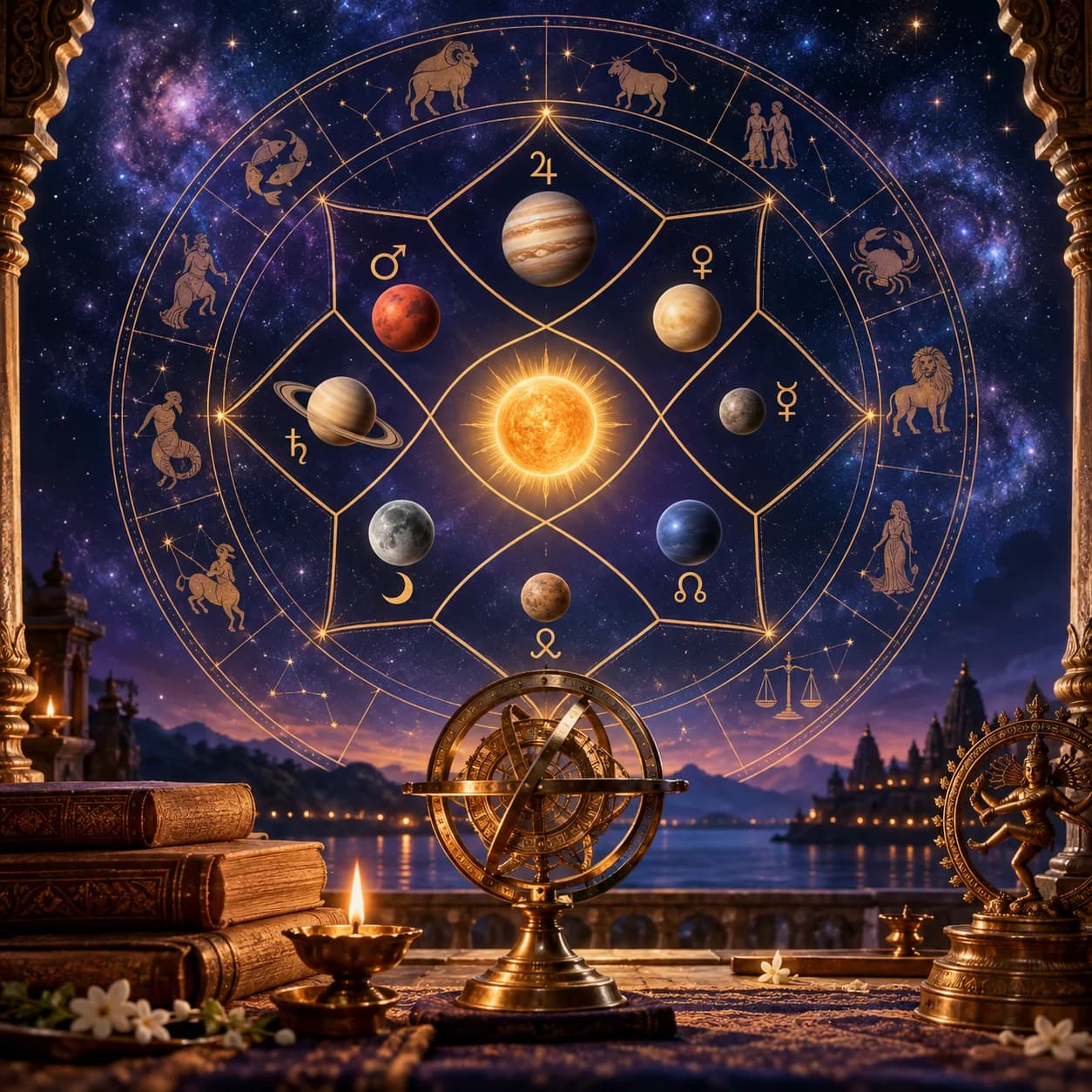
A birth chart, also called a natal chart or horoscope in the technical sense, is a two-dimensional diagram of the sky as seen from a particular location at a particular moment. Most commonly, that moment is a person's birth. The chart is not a photograph or a mystical vision; it is a calculated map. It shows where the Sun, Moon, planets, and other celestial points appeared against the backdrop of the zodiac at that exact time and place. Because the sky is always moving, even a few minutes or a few miles can change the chart's details. This is why astrologers ask for a precise birth time and location when they cast a chart. The word horoscope itself comes from Greek roots meaning 'hour marker,' a reminder that the chart is tied to a specific hour. In everyday language, horoscope often refers to a short sun-sign forecast, but in astrology's technical vocabulary it means the chart itself. This article uses the term in that technical sense.
How a Chart Is Calculated
Calculating a birth chart is a matter of astronomy and geometry, not intuition. The astrologer or software begins with the date, time, and geographic coordinates of birth. Using ephemeris tables or astronomical algorithms, the positions of the Sun, Moon, and planets are determined along the ecliptic, the apparent path of the Sun through the sky. These positions are expressed in zodiacal longitude, typically in degrees and minutes of a sign. Next, the astrologer calculates the ascendant, the degree of the zodiac rising on the eastern horizon at that moment, and the midheaven, the degree culminating at the meridian. From these, a house system is used to divide the chart into twelve houses, each representing a different area of life. Different house systems exist, and astrologers may choose one based on tradition or preference. The result is a wheel-shaped diagram with symbols for planets, signs, and houses. This calculation phase is objective and reproducible: two astrologers using the same birth data and the same house system should get the same chart. Interpretation, by contrast, is where subjectivity and tradition enter.
The Difference Between Calculation and Interpretation
It is important to distinguish calculation from interpretation. Calculation produces the chart: the positions of celestial bodies and the geometric relationships between them. Interpretation assigns meaning to those positions. For example, a planet in a particular sign is a calculated fact; saying that it signifies a certain personality trait is an interpretation. Astrologers draw on a body of traditional symbolism, modern psychological theory, and personal experience to build an interpretation. They may consider the elements and modalities of the signs, the aspects (angles) between planets, the placement of planets in houses, and the chart as a whole. No single placement is read in isolation. A responsible astrologer will avoid claiming that a chart determines a person's fate or that a specific placement guarantees a specific outcome. Instead, the chart is treated as a symbolic map that can suggest tendencies, themes, and timing. This distinction matters because it keeps astrology honest about what it is doing: interpreting symbols, not measuring physical forces.
Why Birth Time and Place Matter
The ascendant and the houses depend on the exact time and location of birth. The ascendant moves through all twelve signs in about twenty-four hours, changing roughly every two hours. The midheaven and house cusps also shift with time and latitude. This means that two people born on the same day in the same city but a few hours apart can have very different charts, even though their Sun signs are identical. For this reason, astrologers often ask for a birth certificate or a recorded time. When an exact time is unknown, some astrologers use solar or noon charts, or they may attempt rectification, a process of working backward from known life events to estimate a birth time. Rectification is controversial and not always reliable. A chart cast for an approximate time should be treated as provisional, especially regarding the ascendant and house placements. This is a practical example of how calculation and interpretation interact: uncertain input leads to uncertain output, and honest astrologers acknowledge that.
The Sun Sign and the Whole Chart
Popular horoscope columns focus on the Sun sign, the zodiac sign the Sun occupied at birth. This is a useful shorthand, but it is only one piece of a much larger picture. The Moon sign describes emotional needs and instincts; the rising sign, or ascendant, describes how a person meets the world. Mercury relates to communication and thought, Venus to values and relationships, Mars to drive and action, Jupiter to growth and belief, Saturn to structure and limitation. The outer planets—Uranus, Neptune, Pluto—are often interpreted as generational or transformative influences. Aspects between planets, such as conjunctions, squares, and trines, describe how these energies interact. Houses show where in life these energies are likely to play out: career, family, health, relationships, and so on. A full chart reading weaves these factors together. It is not a list of traits but a conversation among symbols. This is why two people with the same Sun sign can be quite different, and why a serious astrological reading takes time and context.
What a Birth Chart Is Not
A birth chart is not a scientific instrument in the sense that a thermometer or a telescope is. It does not measure a physical force that has been demonstrated to influence human behavior. Astrology is a symbolic system, and its claims are not currently supported by mainstream science. Many scientists point out that the constellations have shifted since the zodiac was codified, and that the gravitational influence of distant planets on a newborn is negligible. Astrologers often respond that astrology is not about physical causation but about meaning and correlation. This is a philosophical difference, not a settled empirical one. A birth chart is also not a fixed script. It does not say that a person will definitely experience a particular event. It can suggest themes and timing, but it cannot override personal choice, circumstance, or randomness. Treating a chart as a deterministic blueprint can lead to fatalism, which most thoughtful astrologers reject. A chart is better understood as a symbolic mirror, a tool for reflection, and a language for talking about personality and life cycles.
How to Approach a Birth Chart Responsibly
If you are curious about your birth chart, start by gathering accurate birth data: date, time, and city. You can then use free or paid software to generate the chart. When you look at it, remember that you are looking at symbols, not verdicts. A placement may resonate or it may not; both responses are informative. Avoid using a chart to make major life decisions without other forms of counsel. Astrology is not a substitute for medical, financial, or legal advice. If you consult an astrologer, ask about their approach and training. A good astrologer will be clear about the limits of what a chart can show and will not make frightening predictions. They will also respect your autonomy. Finally, keep a sense of curiosity and skepticism. The value of a birth chart lies not in its predictive power but in the questions it invites: What patterns do I notice in myself? What themes keep returning? How do I want to respond? Used this way, astrology can be a creative and reflective practice, even for those who do not believe it describes objective reality.
Sources and further reading
CHANI, 'What is a birth chart?' https://www.chani.com/astro-education/what-is-a-birth-chart YouTube, 'Astrology for Beginners: How to Read a Birth Chart' https://www.youtube.com/watch?v=EPUd7pQHKuo Allure, 'Birth Charts 101: Understanding the Planets and Their Meanings' https://www.allure.com/story/astrology-birth-chart-reading Quora, 'What is horoscope all about and how does the prediction work?' https://www.quora.com/What-is-horoscope-all-about-and-how-does-the-prediction-work Birthchart.net, 'Professional Birth Chart Reading with extensive explanation' https://www.birthchart.net/ Facebook group discussion, 'How do astrologers use birth charts to make predictions and...' https://www.facebook.com/groups/1572893699951268/posts/1770008353573134/