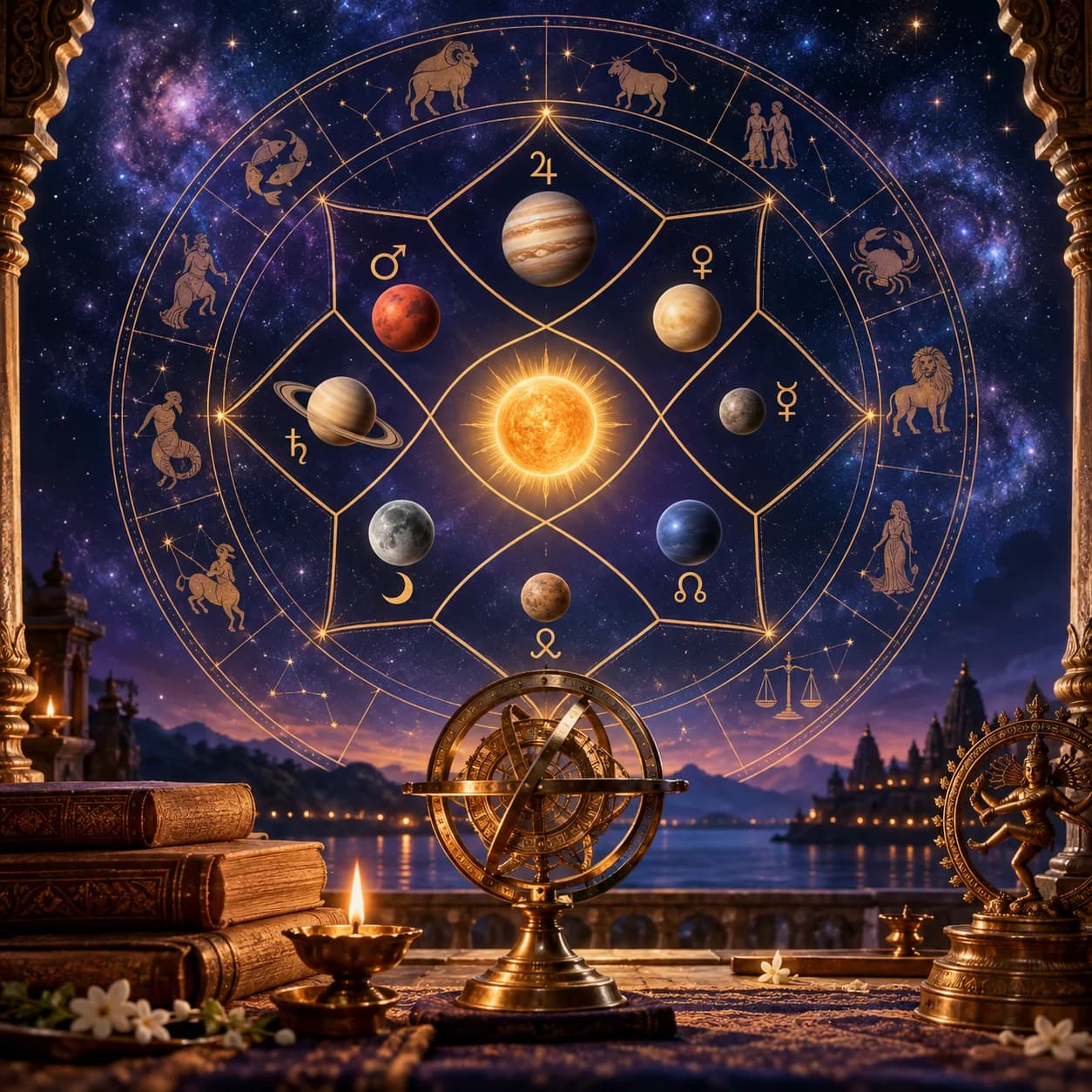

What Is a Birth Chart?
A birth chart—also called a natal chart—is a two-dimensional map of the sky at the exact moment and location of your birth. It shows where the Sun, Moon, planets, and other celestial points were positioned relative to the Earth and the zodiac. Think of it as a snapshot: if you could freeze the sky at your first breath and flatten it onto paper, you'd have your birth chart. Astrologers use this map as a symbolic tool for reflection, not as a scientific instrument. It doesn't predict events or define your fate; instead, it offers a language for describing personality tendencies, emotional patterns, and life themes. The chart is personal because the sky is always moving—no two moments are identical, so no two charts are exactly alike.
Calculation vs. Interpretation: Two Different Steps
It's important to separate calculation from interpretation. Calculation is the precise, mathematical part: you need your date, time, and place of birth to determine the positions of celestial bodies. Astrologers use ephemerides—tables of planetary positions—and geometry to plot these points on a circular chart. This step is objective and repeatable; anyone with the same birth data will get the same chart. Interpretation, on the other hand, is subjective and symbolic. It involves assigning meaning to the placements based on astrological tradition, psychology, and personal insight. Two astrologers might interpret the same chart differently. Calculation gives you the map; interpretation is how you read it. Beginners should first learn to calculate or obtain an accurate chart before diving into meaning.
The Core Components: Planets, Signs, Houses, and Aspects
A birth chart has four main building blocks. Planets (including the Sun and Moon) represent different drives or functions—for example, the Sun often symbolizes core identity, while the Moon relates to emotional needs. Signs are the twelve zodiac segments that color how a planet expresses itself; a planet in Leo may act differently than the same planet in Virgo. Houses are twelve divisions of the chart representing areas of life, such as relationships, career, or home. Finally, aspects are the angular relationships between planets—like conjunctions, squares, or trines—that show how different parts of the chart interact. Together, these components create a complex, layered picture. Beginners can start by identifying the Sun sign, Moon sign, and rising sign (ascendant), which are often considered the three most personal points.
Why Birth Time and Place Matter
The exact time and location of your birth are crucial for an accurate chart. The rising sign, for instance, changes approximately every two hours, so even a small error in birth time can shift the entire house layout. The Moon moves quickly too, covering about 12 to 15 degrees per day, so its sign can change within a day. If you don't know your birth time, you can still calculate a chart for noon or sunrise, but the rising sign and house placements may be uncertain. Many astrologers recommend obtaining a birth certificate or asking family members for the exact time. Place matters because it determines the local horizon and the orientation of the chart. Without accurate data, interpretation becomes more speculative.
A Beginner’s Approach to Reading a Chart
When you first look at a birth chart, it can feel overwhelming. A good starting point is to identify the Sun, Moon, and rising sign—often called the “big three.” The Sun sign describes your core sense of self and vitality; the Moon sign reflects your emotional world and instincts; the rising sign shows how you approach new situations and how others may perceive you. Next, notice which houses these points fall into, as that adds context. For example, a Sun in the 10th house might emphasize public life or career, while a Moon in the 4th house could highlight family and home. After that, you can explore the other planets one by one, reading their sign and house. Finally, look for aspects—lines connecting planets—to see how these energies converse. This step-by-step method keeps the process manageable and grounded.
Common Misconceptions and Ethical Considerations
Birth charts are often misunderstood as fortune-telling devices that predict specific events. In reality, most modern astrologers view the chart as a symbolic map for self-reflection, not a crystal ball. It doesn't determine your choices or guarantee outcomes. Another misconception is that your Sun sign is the only thing that matters—but the Sun is just one piece of a larger puzzle. It's also important to avoid treating astrology as professional advice. A birth chart cannot diagnose medical conditions, offer legal counsel, or replace therapy. If you're facing serious challenges, consult qualified professionals. Astrology can be a tool for insight and personal growth, but it should be used responsibly and with an awareness of its limits.
How to Get Started
To begin exploring your birth chart, you'll need your birth date, time, and city. Many free online calculators can generate a chart for you; just enter the data and you'll see a circular diagram with symbols. Take time to learn the glyphs for planets and signs—they're like a new alphabet. Start with the big three, then gradually add other planets. Keep a journal of your observations and see how the symbolism resonates with your lived experience. Remember that interpretation is a skill that develops over time. You don't need to memorize everything at once. Join a beginner-friendly astrology community or read introductory books to deepen your understanding. Above all, approach the chart with curiosity, not certainty—it's a mirror for reflection, not a rulebook.
Sources and further reading
1. Astrology for Beginners: How to Read a Birth Chart - YouTube (https://www.youtube.com/watch?v=EPUd7pQHKuo). 2. The First 7 Steps I Take When Interpreting a Birth Chart (https://alicebell.substack.com/p/the-first-7-steps-i-take-when-interpreting). 3. r/astrology - A “How to read your birth chart” guide for those looking (https://www.reddit.com/r/astrology/comments/frbefi/a_how_to_read_your_birth_chart_guide_for_those/). 4. What is a birth chart? - CHANI (https://www.chani.com/astro-education/what-is-a-birth-chart). 5. A Beginner's Guide to Reading a Birth Chart - ELLE (https://www.elle.com/horoscopes/a44666453/how-to-read-a-birth-chart/). 6. Natal Chart: How does astrology work? - Co – Star (https://www.costarastrology.com/how-does-astrology-work/what-is-a-natal-chart).