What a Birth Chart Is
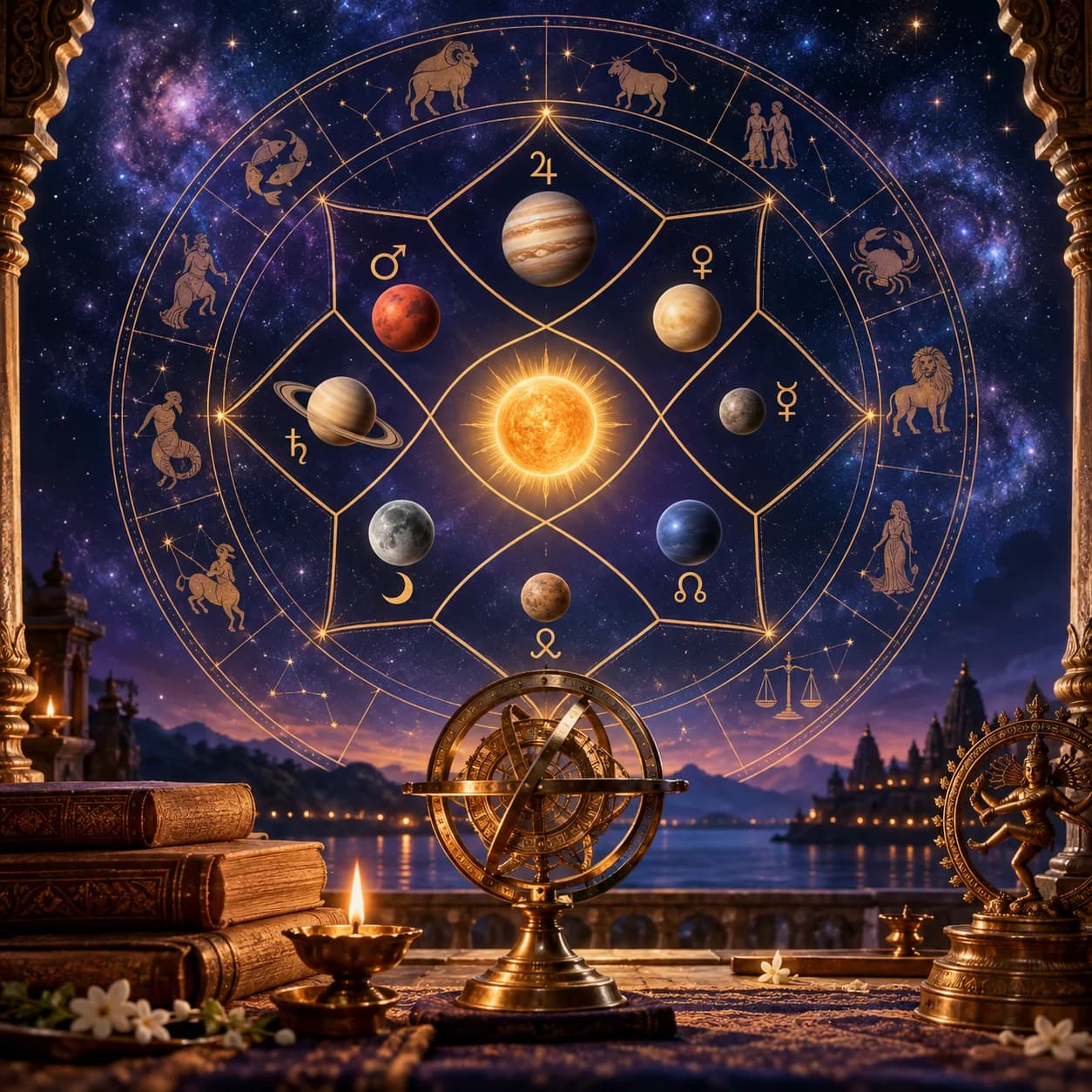
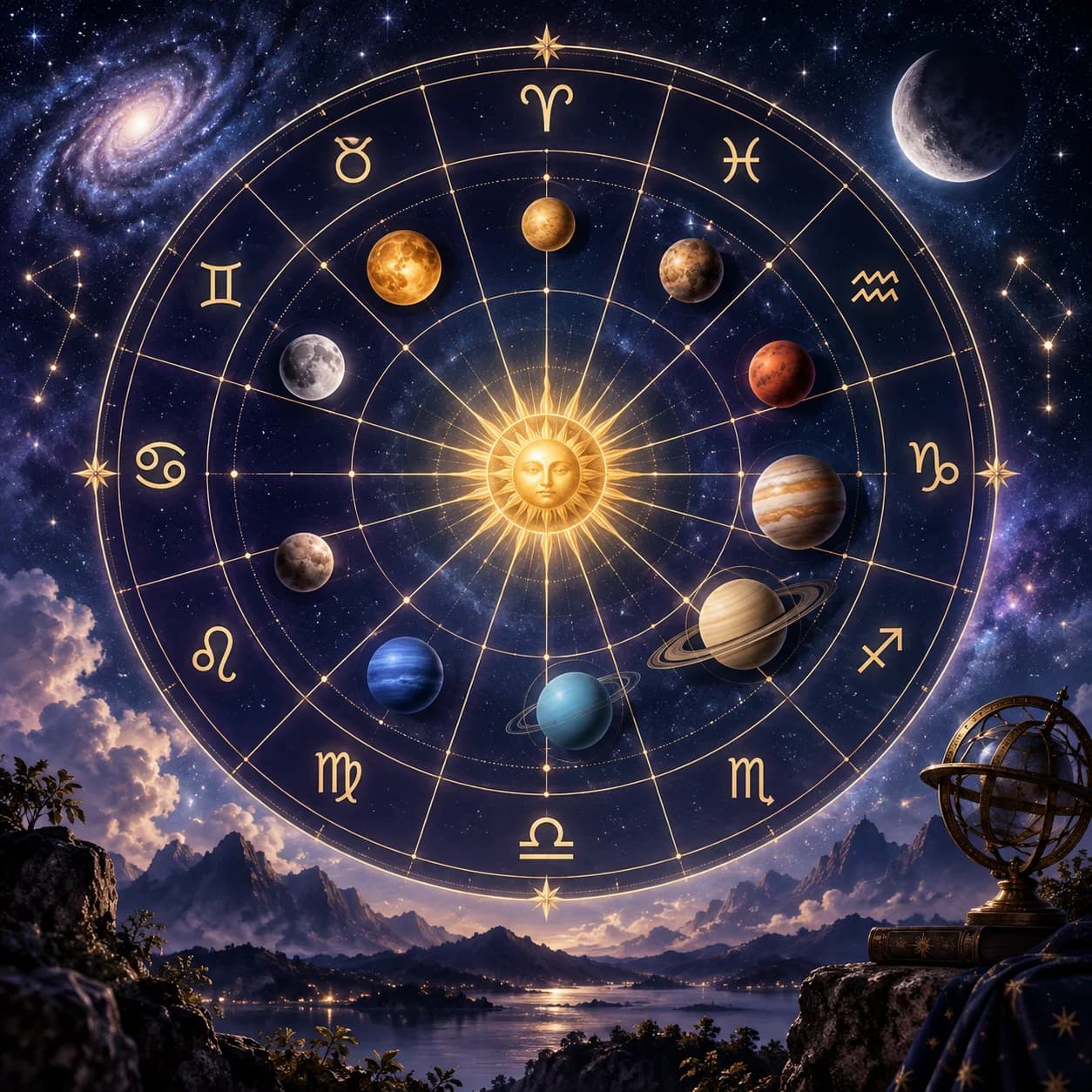
A birth chart, also called a natal chart or natal horoscope, is a diagram of the sky at a specific moment and place—most commonly the moment and place of a person's birth. It is not a photograph, but a symbolic map. The chart shows where the Sun, Moon, and planets appeared against the backdrop of the zodiac at that exact time, along with the rising sign and the twelve houses that divide the chart into areas of life. Because the Earth rotates and the planets continue moving, the chart changes from moment to moment and from place to place. Two people born on the same day but hours apart, or in different cities, will have different charts. This is why astrologers ask for a birth date, time, and location: those details are the coordinates that make the map specific. The chart itself is neutral data. It becomes meaningful only when a person or tradition assigns symbolic significance to the positions.
How Planetary Positions Are Calculated
Calculating planetary positions is an astronomical task before it is an astrological one. Astronomers and astrologers use ephemerides—tables or software that list the celestial longitude and latitude of the Sun, Moon, and planets for given dates and times. These positions are measured along the ecliptic, the apparent path of the Sun across the sky, and are expressed in degrees and minutes of the zodiac signs. The birth time and location determine the ascendant and the house cusps, which are calculated using the local horizon and the Earth's rotation. Different house systems, such as Placidus, Whole Sign, or Equal House, can produce slightly different house placements, so the same planetary position may fall in a different house depending on the system used. This is a technical, mathematical process. It does not require belief in astrology to perform; it requires accurate input data and a reliable ephemeris. Errors in birth time, time zone, or location can shift the ascendant and house placements significantly, which is why astrologers often note the importance of a verified birth record.
The Planets as Symbolic Drives
In astrological interpretation, the planets are not literal causes of events. They are symbols for central drives, needs, and functions of the psyche. The Sun is often associated with identity, vitality, and the core sense of self. The Moon represents emotional needs, instinct, and the inner world. Mercury is linked to thinking, communication, and learning. Venus symbolizes love, attraction, values, and pleasure. Mars stands for drive, assertion, courage, and desire. Jupiter is associated with growth, meaning, and expansion, while Saturn represents structure, limits, discipline, and maturity. The outer planets—Uranus, Neptune, and Pluto—are often connected with generational themes, disruption, imagination, and deep transformation. These meanings are not fixed laws; they are part of a symbolic language that astrologers interpret in context. A planet's meaning also depends on its sign, house, and aspects to other planets. For example, Mars in one sign may express drive differently than Mars in another, and Mars in the first house may be more visible in a person's behavior than Mars in the twelfth.
Signs, Houses, and Aspects
Planetary positions gain nuance through three additional layers: sign, house, and aspect. The sign describes the style or quality of a planet's expression—how the drive tends to operate. The house describes the area of life where that drive is most likely to be focused, such as relationships, career, home, or learning. Aspects are angular relationships between planets, such as conjunctions, squares, trines, and oppositions. They describe how the planets interact: whether they support each other, challenge each other, or blend their energies. For instance, a planet in the seventh house may emphasize partnership, while a square between two planets may suggest tension that requires conscious integration. Astrologers also consider the sect of the chart—whether it is a day or night chart—which can influence how certain planets are weighted. These layers are not independent; they form a web. Interpretation involves reading the web as a whole rather than isolating one placement. A single planet in a single sign is rarely the whole story.
Calculation Is Not Interpretation
It is important to distinguish calculation from interpretation. Calculation is the process of determining where the planets were at a given time and place. It is based on astronomy, mathematics, and ephemerides. Interpretation is the process of assigning meaning to those positions using astrological tradition, symbolism, and the interpreter's judgment. The two are often conflated in popular astrology, but they are different kinds of activity. A calculated chart is a set of data points. An interpreted chart is a narrative that a person or tradition builds from those data points. Different astrologers may interpret the same chart differently, depending on their training, the house system they use, and the questions they are asking. This does not make calculation meaningless; it means that interpretation is not a single, fixed answer. It is a symbolic reading, not a scientific measurement of personality or future events. Recognizing this distinction helps readers approach astrology with clarity and appropriate skepticism.
Reading a Chart Responsibly
A responsible approach to birth chart planetary positions avoids certainty and professional advice. Astrology can be a tool for reflection, self-awareness, and storytelling, but it is not a substitute for medical, financial, legal, or psychological guidance. A chart does not determine a person's fate, and it does not describe a person completely. It is one symbolic lens among many. When reading a chart, it is helpful to treat placements as prompts for questions rather than as verdicts. For example, a strong Saturn placement might invite reflection on themes of responsibility and patience, but it does not mean a person is doomed to hardship. Similarly, a prominent Venus does not guarantee a happy relationship. The value of the chart lies in the conversation it opens, not in the predictions it claims to make. Readers should also be cautious about relying on unverified birth times or generic sun-sign descriptions. A full chart requires accurate data and careful, contextual interpretation. Used thoughtfully, planetary positions can be a rich language for exploring human experience without claiming to explain it entirely.
Sources and further reading
Allure, "Birth Charts 101: Understanding the Planets and Their Meanings": https://www.allure.com/story/astrology-birth-chart-reading CHANI, "What is a birth chart?": https://www.chani.com/astro-education/what-is-a-birth-chart YouTube, "Astrology Birth Chart Explained": https://www.youtube.com/watch?v=W1s23eDKRQs Facebook, "Understanding planetary positions in a birth chart": https://www.facebook.com/groups/vedicastrologyforum/posts/8629154677135854 Alice Bell, "The First 7 Steps I Take When Interpreting a Birth Chart": https://alicebell.substack.com/p/the-first-7-steps-i-take-when-interpreting YouTube, "6 Components of an Astrological Birth Chart - For Dummies": https://www.youtube.com/watch?v=_LXQ-xSWb0M