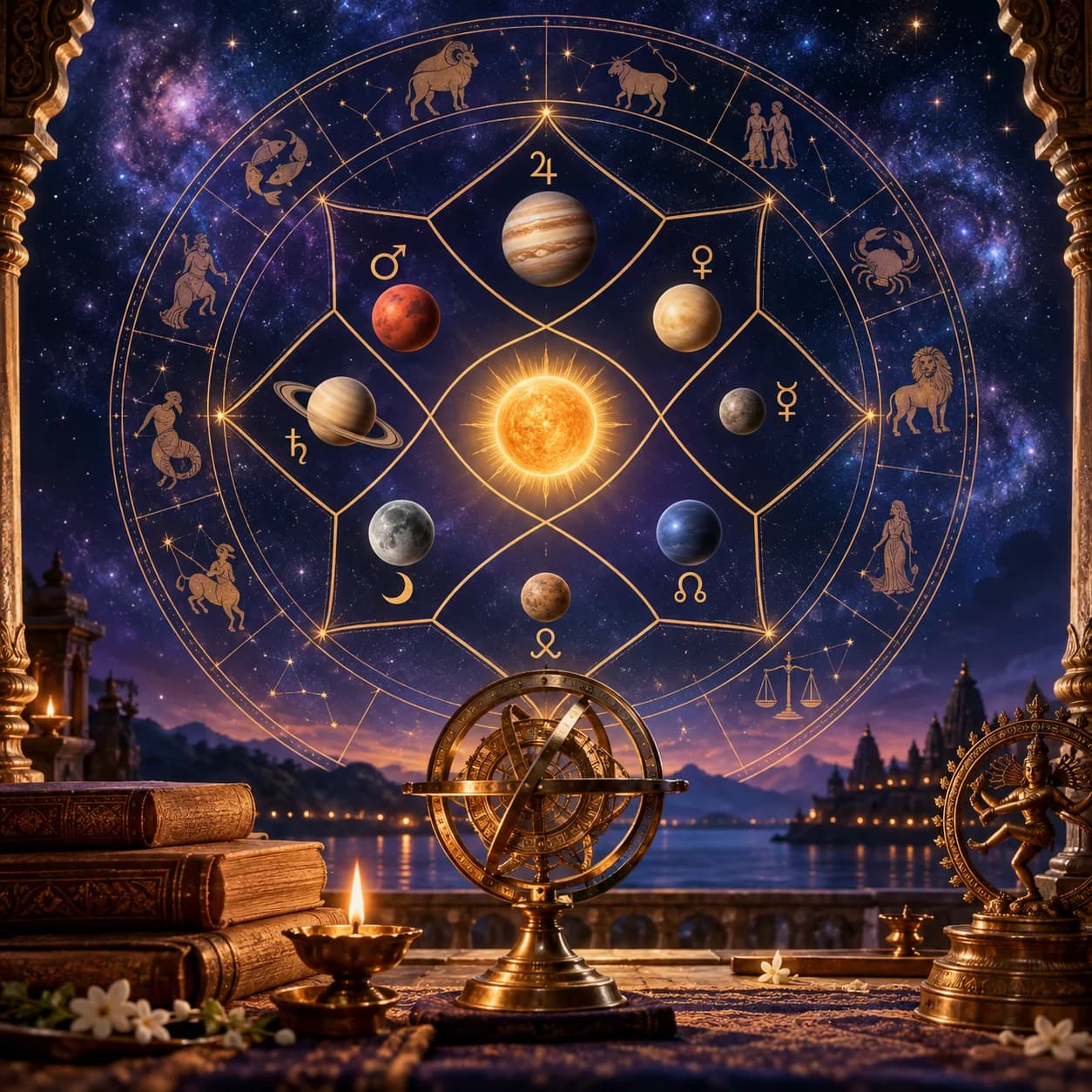

The sky becomes local
A birth chart is not only a ring of zodiac signs. It is also divided into twelve houses anchored to a specific time and place. Those houses turn an abstract sky into a local one: they describe where a planet's concerns meet lived experience.
The four angles
The four angular houses provide the structure. The first begins at the Ascendant and concerns embodiment and approach. The fourth descends toward roots, home, and private foundations. The seventh meets the other through partnership and opposition. The tenth rises toward visibility, vocation, and public consequence.
Succedent and cadent houses
The houses that follow the angles are called succedent. Traditionally, they consolidate what the angles initiate: resources in the second, creativity and pleasure in the fifth, shared obligations in the eighth, and alliances or hopes in the eleventh. Cadent houses prepare movement and transition through learning, work, belief, and retreat.
Why houses are not signs
A house does not equal a sign. The first house is not inherently Aries, nor is the eighth house simply Scorpio. That popular shortcut erases the actual sign on the cusp and its ruler. Read the house topic, then the sign governing its cusp, then the condition of that sign's planetary ruler.
Calculation comes before meaning
House systems can place cusps differently, especially at high latitudes. That is not a reason to hide the choice. A serious chart should state its system and calculate from an accurate historical time zone. Interpretation begins after those facts are fixed.